

Insights and practical guides
Building a Scalable Invoicing System for SaaS Businesses
 By
Published
13 min read
Summary
Invoicing is often one of the simplest parts of running a SaaS business in its early stages.
A customer subscribes to a service, receives an invoice, and makes a payment. With a limited number of customers and subscription plans, this process may require little attention.
As the business grows, however, invoicing becomes more complicated.
Customers upgrade or downgrade subscriptions, billing periods change, usage-based charges are introduced, and refunds or corrections become necessary. Businesses may also expand into new countries, where invoicing and tax requirements differ.
What initially worked as a simple process for generating invoices must now support a growing number of commercial and financial scenarios.
Building a scalable invoicing system is therefore not just about generating more documents. It is about maintaining consistent, accurate, and traceable financial records as the business evolves.
1. Why SaaS invoicing is different from traditional invoicing
Many businesses issue invoices for individual sales or completed services.
SaaS businesses frequently operate on recurring commercial relationships instead.
A customer may subscribe to a service for €49 per month, upgrade to a €99 plan, purchase additional features, and later change to annual billing.
Each change can affect how the customer is charged and what needs to be documented.
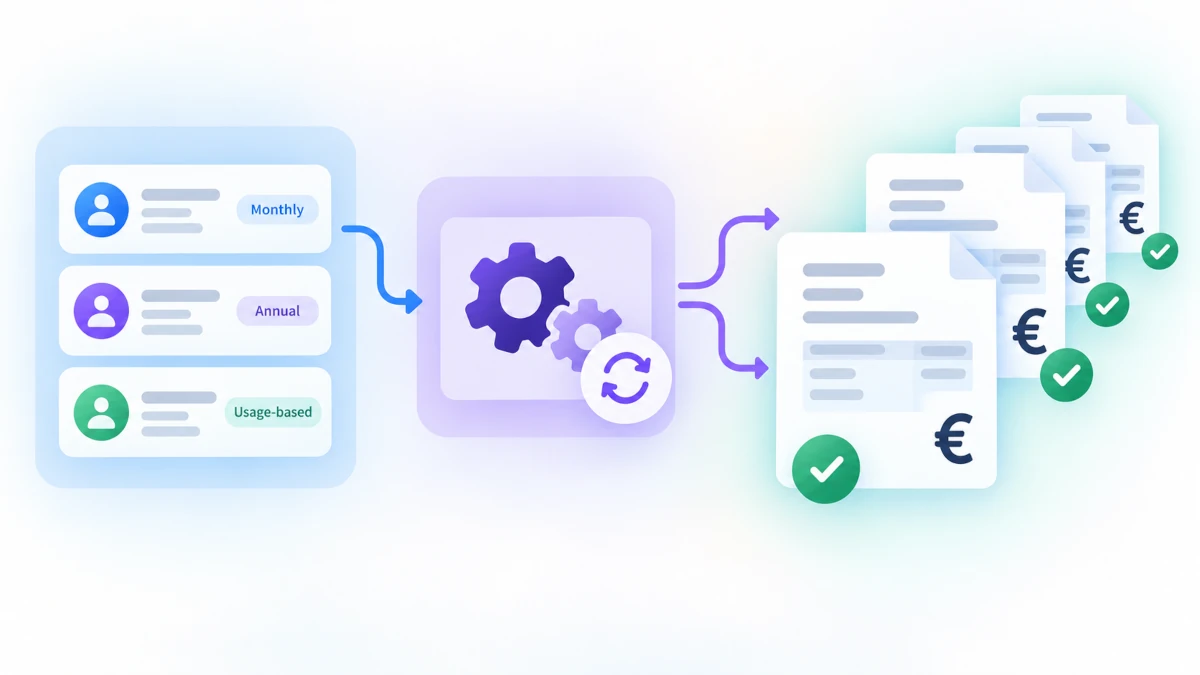
Common SaaS billing scenarios include:
- Monthly and annual subscriptions.
- Free trials that convert into paid plans.
- Upgrades and downgrades during an active billing period.
- Usage-based or consumption-based charges.
- Discounts, promotional periods, and credits.
- Multiple subscriptions under one customer account.
- Subscription cancellations and refunds.
Not every billing event requires a new invoice, and the applicable invoicing requirements depend on the transaction and jurisdiction.
Nevertheless, an invoicing system needs enough information to document the relevant financial events correctly.
The challenge grows when these events occur automatically rather than through manual administrative processes.
2. Separate subscription management from invoicing
One of the most important architectural decisions is distinguishing between the customer's subscription and the invoices issued for it.
A subscription represents a commercial arrangement.
It may define the plan, billing frequency, price, included services, renewal date, and current subscription status.
An invoice, by contrast, is a financial document representing a particular charge or transaction.
Consider a customer subscribed to a €100 monthly plan.
The subscription remains active over several months, while a separate invoice may be generated for each relevant billing period.
If the customer changes to a more expensive plan, the subscription details may change immediately, while the associated billing adjustments need to be reflected in the appropriate financial documents.
These are connected but distinct records.
A scalable design should avoid treating the subscription itself as an invoice or assuming that every subscription change automatically requires the same invoicing action.
Why this separation matters
It allows businesses to:
- Change subscription plans without rewriting historical invoices.
- Maintain a clear record of what was billed in each period.
- Apply billing adjustments according to consistent rules.
- Track subscription and invoice statuses independently.
- Integrate invoicing with different subscription-management systems.
The subscription system determines what the customer should be charged under the commercial arrangement.
The invoicing system documents those charges according to the applicable business and legal requirements.
Separating these responsibilities makes both systems easier to maintain.
3. Establish a reliable invoice lifecycle
An invoice should not be treated as an editable document that can be changed indefinitely.
A practical invoicing system typically distinguishes between preparation, issuance, subsequent payment tracking, and any necessary corrections.
A simplified operational lifecycle might involve:
Preparation
The system collects customer information, billing details, taxable amounts, and other information needed to generate the invoice.
The document may remain a draft while this information is validated.
Issuance
The invoice is formally issued, receives the required identifiers, and becomes part of the business's financial records.
Payment tracking
The business records whether the invoice remains outstanding, has been paid, or has been partially paid, where applicable.
Corrections
If a document requires correction, the system follows the legally appropriate procedure and preserves the relationship between the original document and subsequent adjustments.
This distinction is particularly important for businesses issuing invoices automatically.
A generated invoice should not be considered valid simply because a PDF was successfully created.
The system also needs to ensure that the underlying information is correct and that issuance follows the relevant requirements.
Preserve the original financial history
Once an invoice has been issued, changing its historical details without an appropriate correction process can create inconsistencies.
For example, if a customer is invoiced €100 and later receives a €20 reduction, silently changing the original invoice to €80 may not be an acceptable approach.
Depending on the applicable rules, a credit note or another correction document may be necessary.
A reliable invoicing system should preserve the original record and the reason for subsequent changes.
This creates a traceable history rather than a collection of documents whose previous contents cannot be reconstructed.
4. Handle subscription changes without losing billing accuracy
Subscription changes are among the most common sources of complexity in SaaS invoicing.
Consider a customer who subscribes to a €60 monthly plan and upgrades to a €120 plan halfway through the billing period.
The business now needs to determine how the change affects the customer's charges.
Possible approaches include:
- Applying the new price at the next renewal.
- Charging an immediate adjustment.
- Crediting unused time on the original plan.
- Calculating a prorated charge for the remaining period.
The appropriate approach depends on the business's pricing policy, customer agreement, and billing configuration.
The invoicing system must then document the resulting charges and adjustments correctly.
Example: A mid-cycle subscription upgrade
Assume the business uses a simplified 30-day billing period and the customer upgrades exactly halfway through it.
| Component | Amount |
|---|---|
| Original monthly plan | €60 |
| Credit for unused half of original plan | −€30 |
| Charge for remaining half of new plan | €60 |
| Additional amount to bill | €30 |
Illustrative calculation excluding taxes, rounding differences, and provider-specific billing rules.
The example demonstrates why an invoicing system needs access to more than the customer's current subscription price.
It may also need the previous plan, effective change date, billing period boundaries, and applicable adjustment rules.
Without these details, the generated invoice may not accurately represent the transaction.
For a provider-specific example, see Stripe's documentation on subscription prorations (opens in a new tab).
5. Design automation around reliable events
Manual invoice generation may work for a small SaaS business, but it becomes increasingly inefficient as customer numbers grow.
Automated invoicing can reduce repetitive work, provided that the underlying process is reliable.
In many SaaS architectures, invoicing is triggered by business events.
Examples include:
- A subscription begins.
- A new billing period starts.
- A chargeable usage period closes.
- An additional service is purchased.
- A billing adjustment is approved.
- A correction document is required.
These events may originate in a subscription platform, billing system, customer portal, or another business application.
An automated invoicing process should validate each event before generating a document.
Prevent duplicate invoices
One particularly important challenge is processing the same event more than once.
Imagine a subscription renewal event is delivered twice because of a network retry.
If the invoicing system blindly generates an invoice for every received event, the customer could receive two invoices for the same billing period.
A reliable implementation should use idempotent operations: repeated processing of the same logical request should not create duplicate financial documents.
This can involve stable event identifiers, internal invoice-generation references, database constraints, and appropriate checks before issuance.
The objective is to ensure that temporary network errors or repeated notifications do not result in duplicated invoices.
Handle failures without losing transactions
Automation should also account for unsuccessful operations.
If invoice generation fails because customer information is incomplete or an external dependency is unavailable, the system should record the failure.
Depending on the situation, it may retry safely or require manual intervention.
A scalable solution makes these exceptions visible rather than silently dropping them.
Stripe's idempotent-request documentation (opens in a new tab) illustrates how repeated requests can avoid performing an operation twice.
6. Connect invoices with payment records
Invoicing and payment collection are closely related, but they are not the same operation.
An invoice represents a documented charge or transaction.
A payment record represents an attempt or event associated with transferring money.
A scalable system should preserve the relationship between these records without assuming that every invoice has exactly one payment.
For example:
- A customer may pay one invoice through several partial payments.
- A single payment may cover multiple invoices.
- A payment attempt may fail and later succeed after a retry.
- A customer may receive a partial refund after paying.
- A payment may be confirmed before the related provider payout occurs.
These scenarios become difficult to manage when the invoicing system stores only a simple paid/unpaid flag.
A more flexible approach is to maintain separate payment information and connect it to the relevant invoices through identifiable references and payment allocations.
Payment status is not settlement status
For businesses using external payment providers, a successful customer payment does not necessarily mean that the funds have already reached the business's bank account.
Payment confirmation, settlement, and payout may happen at different times.
These events should remain distinguishable.
This is also why a system's treatment of invoice payment status should follow clear, documented rules rather than simply copying every status received from a payment provider.
For more detail, see our article Understanding the Payment Lifecycle: From Authorization to Settlement.
7. Build compliance into the invoicing process
As SaaS businesses expand, invoicing requirements can become more complicated.
Different countries may have rules concerning:
- Required invoice information.
- Invoice numbering and identification.
- VAT treatment and tax information.
- Document correction procedures.
- Electronic invoicing formats and transmission.
- Record retention and accessibility.
- Language and currency requirements.
For businesses operating in the European Union, some invoicing requirements are harmonized through EU VAT legislation, while individual Member States retain national rules in certain areas.
A system designed to support multiple markets should therefore avoid assuming that one country's invoicing requirements apply everywhere.
Keep jurisdiction-specific rules configurable
A scalable approach separates the general invoicing workflow from the rules applicable to particular jurisdictions.
For example, the system may need to apply different validation requirements, document formats, or correction procedures depending on the relevant country and transaction type.
This allows the business to adapt to additional markets without rebuilding the entire invoicing process.
However, software configuration alone does not establish legal compliance.
Businesses still need to determine the applicable obligations for their transactions and ensure that the system implements them correctly.
Electronic invoicing is more than a PDF
An invoice created as a PDF is not necessarily equivalent to a structured electronic invoice.
Structured e-invoicing commonly involves machine-readable document formats that can be exchanged and processed automatically.
As European electronic invoicing and digital reporting requirements evolve, businesses may need to support additional document formats or transmission mechanisms.
A scalable invoicing architecture should avoid making the PDF document its only source of financial information.
Instead, it should maintain structured invoice data from which appropriate document representations and integrations can be generated.
See the European Commission's guidance on VAT invoicing rules (opens in a new tab) and structured e-invoicing (opens in a new tab) for the distinction between shared EU requirements, national rules, and structured invoice data.
8. Maintain reliable customer and billing information
Invoice accuracy depends heavily on the quality of the underlying customer information.
For B2B SaaS businesses, relevant details may include:
- Legal company name.
- Billing address.
- Applicable tax identifiers.
- Country and jurisdiction.
- Billing contact details.
- Invoice delivery preferences.
These details can change over time.
For example, a customer may update its registered address or tax information after several invoices have already been issued.
The system should use the correct information for new documents without silently rewriting previously issued invoices.
Preserving the details used at the time of issuance helps maintain an accurate historical record.
It also makes it easier to explain differences between documents issued at different times.
9. Make invoicing observable and manageable
Scalability is not just about processing thousands of invoices quickly.
It also means being able to understand what is happening when something goes wrong.
A business should be able to answer operational questions such as:
- Which invoices were generated during a billing cycle?
- Which documents failed validation or issuance?
- Are any billing events awaiting processing?
- Were duplicate requests detected?
- Which invoices require manual attention?
- Which documents have been corrected or credited?
These capabilities become especially important as invoicing moves from a manual administrative task to an automated business process.
Useful operational measures include invoice-generation success rates, processing delays, unresolved exceptions, and the number of documents requiring correction.
A system that generates invoices automatically but provides little visibility into failures may create more operational risk than a smaller, well-controlled process.
10. Plan for growth without unnecessary complexity
Building a scalable invoicing system does not necessarily mean developing a large financial platform from the beginning.
For many businesses, a simpler architecture with well-defined responsibilities is a better starting point.
The essential components are:
Reliable billing information
A clear source for customer agreements, subscription changes, prices, and chargeable events.
Structured invoice records
Consistent invoice data, appropriate document identifiers, and preserved issuance history.
Controlled automation
Reliable event processing, duplicate prevention, validation, and failure handling.
Connected payment information
The ability to associate invoices with payments and subsequent financial events.
Adaptable compliance rules
A structure that can accommodate the requirements of supported jurisdictions.
Operational visibility
Tools and records that make exceptions easy to identify and investigate.
A business may implement these capabilities within one application or distribute them across several integrated services.
The most important consideration is that responsibilities and data relationships remain clear.
How A3BSS approaches invoicing
The challenges discussed above highlight why invoicing should be treated as part of a connected financial process rather than simply a document-generation function.
A3BSS is being developed to help businesses manage invoicing and related financial records, with initial invoicing coverage for Bulgaria in EUR and planned support for additional jurisdictions.
Its invoicing and payment capabilities are designed to be usable independently or together.
This allows businesses to approach invoice documentation and payment integration according to their particular operational needs, without requiring both capabilities to be adopted at the same time.
You can learn more about the planned functionality on the A3BSS Invoicing and Payments pages.
Final thoughts
Scalable SaaS invoicing is not primarily about producing more invoices.
It is about maintaining financial accuracy as billing arrangements, transaction volumes, customer requirements, and business operations become more complex.
Separating subscriptions from invoices, preserving document histories, handling corrections properly, and connecting payment records all contribute to a more reliable invoicing process.
Automation can reduce administrative effort, but it must be supported by appropriate validation, exception handling, and operational visibility.
For growing SaaS businesses, these foundations help create invoicing processes that can evolve without sacrificing consistency or traceability.