

Insights and practical guides
Why Payment Reconciliation Becomes Difficult as Your Business Grows
 By
Published
10 min read
Summary
As a business grows, managing payments becomes more complicated than simply checking whether customers have paid.
What starts as a straightforward process of matching payments to invoices can gradually involve multiple payment providers, different payment methods, refunds, processing fees, settlement delays, and records spread across several systems.
For SaaS companies, online businesses, and digital service providers, these challenges can become particularly noticeable as transaction volumes increase.
Understanding why payment reconciliation becomes difficult is the first step toward building more reliable financial operations.
What does payment reconciliation involve?
Payment reconciliation is the process of comparing financial records to verify that payments have been recorded correctly and that the corresponding funds and financial movements can be accounted for.
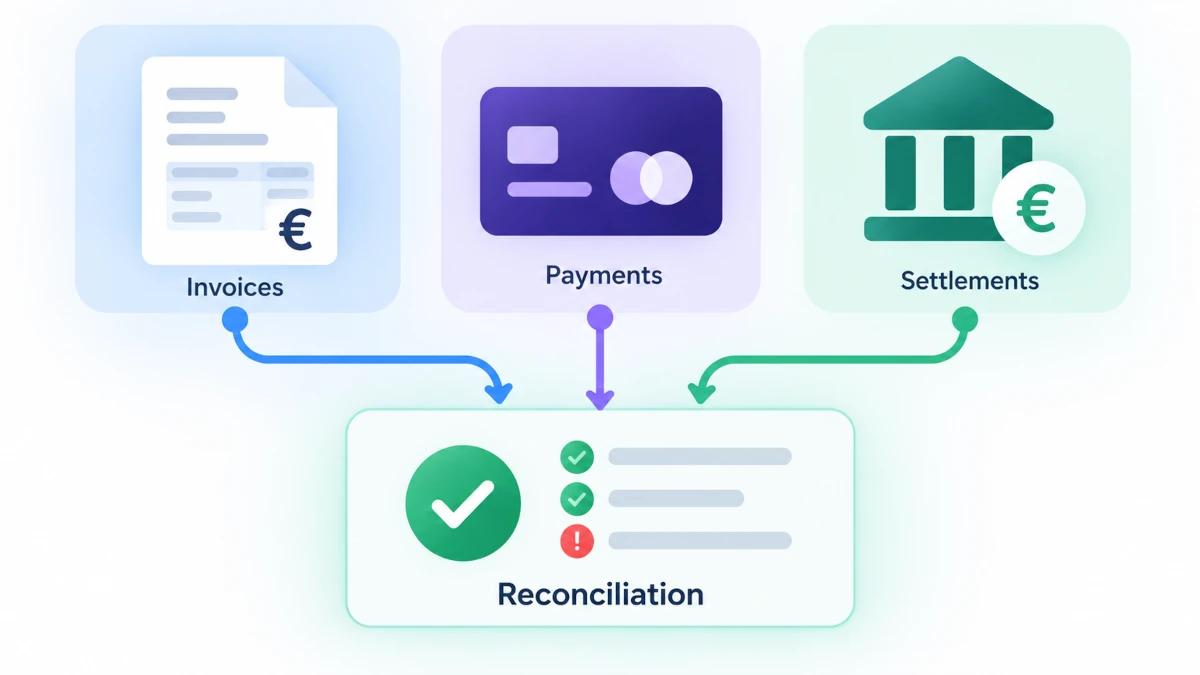
Depending on the business, this may involve matching information from several sources:
- Invoices and billing records: What the business has charged its customers.
- Payment provider records: Which transactions were attempted, completed, refunded, or disputed.
- Settlement reports: How payments, fees, refunds, and adjustments contribute to the amounts payable to the business.
- Bank statements: What funds actually arrived in the business's bank account.
- Accounting records: How these transactions are represented in the company's financial reporting.
These records serve different purposes. They may also be updated at different times and use different identifiers.
For a business processing a small number of transactions, comparing them manually may be manageable. As the number of transactions, payment methods, and systems increases, the same process becomes substantially more demanding.
1. More transactions mean more exceptions
At first glance, reconciliation may appear to be a volume problem: more transactions require more work.
However, the real difficulty often comes from the growing number of exceptions that must be investigated.
Consider an online business processing 50 transactions a month. Even if a few payments need manual attention, identifying and resolving them may be relatively straightforward.
Now consider the same business processing 10,000 transactions monthly.
Even if only 1% of transactions require investigation, that represents 100 separate cases.
These exceptions might include:
- Payments that failed but were later retried successfully.
- Customers who paid an incorrect amount.
- Duplicate payment attempts.
- Partial payments or payments covering multiple invoices.
- Refunds processed after the original transaction.
- Payments whose settlement is still pending.
Each exception can require information from more than one system.
The challenge is therefore not simply processing a larger number of transactions. It is maintaining a reliable way to identify, investigate, and resolve discrepancies.
2. Multiple payment providers fragment financial information
Businesses often begin with a single payment provider.
As they expand, they may introduce additional providers to support different payment methods, countries, currencies, or commercial requirements.
Although this can improve payment flexibility, it also introduces operational complexity.
Each provider may have its own:
- Transaction identifiers and reporting formats.
- Payment statuses and terminology.
- Settlement schedules.
- Fee structures.
- Refund and dispute processes.
- Reporting interfaces and APIs.
For example, a business may collect card payments through one provider, bank-based payments through another, and use an additional provider for specific markets.
The business now needs to consolidate information from several sources to understand its overall payment position.
Without consistent references linking these transactions to the underlying business records, reconciliation can become a process of comparing separate reports and manually identifying which entries belong together.
This is particularly challenging when payment information and invoice records are maintained by different systems.
3. Successful payments do not always match bank deposits
One common source of confusion is the difference between the amount customers pay and the amount ultimately deposited into a business's bank account.
Payment providers may deduct processing fees, refunds, chargebacks, or other adjustments before transferring funds.
Consider a simplified, illustrative example (these are not actual business results or provider fee rates):
| Transaction component | Amount |
|---|---|
| Customer payments collected | €10,000 |
| Processing fees | −€250 |
| Refunds | −€400 |
| Other settlement adjustments | −€50 |
| Net settlement | €9,300 |
In this example, €10,000 in customer payments results in a €9,300 transfer.
Both figures can be correct, but they represent different things.
A business that compares only its total successful payments with its bank deposits may incorrectly interpret the difference as missing money.
Understanding the composition of each settlement is essential.
The process becomes more complicated when a provider combines transactions from several days, applies adjustments from earlier periods, or transfers funds according to a separate payout schedule.
Reconciliation therefore requires visibility not only into individual customer payments but also into how those payments contribute to settlements and bank deposits.
For a provider-specific example, Stripe’s payout reconciliation report (opens in a new tab) groups payments, fees, refunds, and other transactions by payout.
4. Refunds and disputes create additional financial events
A customer payment is not necessarily the final event associated with a transaction.
A payment may later be partially or fully refunded. It may also become subject to a dispute or chargeback.
These events can occur days or weeks after the original payment.
Consider a SaaS customer who purchases an annual subscription and receives an invoice.
The payment succeeds, the invoice is marked as paid, and the transaction is included in a settlement.
Two weeks later, the customer receives a partial refund following a change to their subscription.
The business now needs to maintain a consistent record of:
- The original invoice and payment.
- The amount refunded.
- The updated amount retained by the business.
- Any related billing correction or credit document required under applicable rules.
- The corresponding entries in the payment provider's records and accounting system.
If the billing system and payment provider do not exchange enough information, the records may no longer tell the same story.
A refund might be visible in the payment provider's dashboard while the corresponding invoice or billing records remain unchanged.
Reliable reconciliation depends on preserving the relationship between the original transaction and subsequent financial events.
Stripe’s refund documentation (opens in a new tab) illustrates how full and partial refunds are recorded against an earlier payment.
5. Different systems operate on different timelines
Not every financial event is recorded at the same moment.
An invoice might be issued immediately, a payment confirmed shortly afterward, and the corresponding funds settled and transferred later.
This means a transaction can be complete from the customer's perspective while the bank transfer is still pending.
Different systems may also use different time zones or reporting cutoffs.
For example, a payment completed late on the final day of a month might appear in one system's monthly report but in the following month's settlement report.
Neither record is necessarily incorrect.
The challenge is understanding which date each system represents:
- Invoice issue date.
- Payment initiation or confirmation date.
- Capture or settlement date.
- Payout date.
- Bank posting date.
These distinctions become especially important when preparing financial reports or investigating differences between reporting periods.
A reconciliation process that relies only on transaction dates, without considering the underlying events and their timing, can produce misleading results.
Stripe’s payout documentation (opens in a new tab) distinguishes settlement timing, payout schedules, and bank availability. Details vary by provider and account.
6. Disconnected systems make investigation more expensive
When invoicing, payments, and accounting information live in separate applications, finance teams may need to reconstruct the history of individual transactions manually.
Imagine a customer contacting support because a payment was collected but their invoice still appears unpaid.
Resolving the issue may require checking:
- The invoice in the billing system.
- The payment attempt in the payment provider's dashboard.
- The transaction reference returned by the provider.
- The corresponding payment notification or system log.
- The customer's account and payment allocation.
If these records are not connected, resolving a single discrepancy can involve several people and multiple applications.
As the business grows, this becomes an operational problem rather than an occasional inconvenience.
The goal should not be to eliminate every possible exception. That is rarely realistic.
Instead, businesses need enough information to identify exceptions quickly and understand the relationship between the underlying records.
How businesses can make reconciliation more manageable
Improving payment reconciliation does not necessarily require replacing every existing system.
Often, the most valuable improvements come from establishing consistent processes and better connections between the systems already in use.
Maintain consistent transaction references
Each payment should be traceable to the relevant order, invoice, subscription, or customer account.
Where possible, preserve both internal references and the identifiers provided by external payment services.
These references reduce the need to match transactions manually using amounts, dates, or customer names.
Keep the full payment history
A single status such as "paid" may not provide enough information to explain everything that happened.
Payment attempts, successful collections, refunds, disputes, and relevant adjustments should remain traceable.
Keeping the history makes it easier to investigate discrepancies without losing the context of earlier events.
Separate payment status from settlement status
Knowing that a payment succeeded is not the same as knowing when the corresponding funds reached the business.
Businesses should distinguish customer payment events from provider settlements and bank deposits.
This is particularly important when providers make aggregated payouts.
Reconcile regularly
Waiting until the end of the month to investigate every discrepancy can make problems harder to resolve.
Regular reconciliation helps identify missing records, unexpected differences, and unresolved transactions closer to the time they occur.
The appropriate frequency depends on transaction volume and operational requirements.
Automate predictable matching, investigate exceptions
Automation can reduce repetitive work where records have reliable identifiers and consistent relationships.
However, not every transaction can be matched automatically.
A practical reconciliation process should distinguish between records that can be confidently matched and exceptions requiring investigation.
It should also allow corrections without losing the original transaction history.
Why connected financial records matter
The underlying challenge is often not a lack of information.
Most businesses already have access to invoices, payment provider dashboards, settlement reports, and bank statements.
The difficulty is that these sources describe different parts of the same financial activity.
When those records are disconnected, teams must repeatedly reconstruct the relationship between what was invoiced, what customers paid, what was refunded, and what was ultimately settled.
Connecting these records creates a more consistent foundation for payment tracking, customer support, financial reporting, and operational decision-making.
It also makes it easier to introduce automation without sacrificing traceability.
This is part of the thinking behind A3BSS: bringing invoicing and payment information into a more connected financial record while allowing businesses to use their own payment provider accounts.
A3BSS is being developed to connect invoice documents, payment activity, and financial records.
You can explore the planned capabilities on our Invoicing and Payments pages.
Final thoughts
Payment reconciliation becomes more difficult as businesses grow because financial activity becomes more distributed, more event-driven, and more dependent on information from multiple systems.
Increased transaction volume is only part of the challenge.
Different provider reports, settlement schedules, refunds, disputes, and disconnected billing records all contribute to the complexity.
Businesses that establish consistent references, preserve transaction histories, and connect their financial records are better positioned to manage that complexity.
The objective is not simply to match numbers at the end of a reporting period. It is to maintain a reliable understanding of how financial transactions relate to one another throughout their lifecycle.