

Insights and practical guides
Connecting Invoicing and Payments: Architecture, Challenges, and Best Practices
 By
Published
15 min read
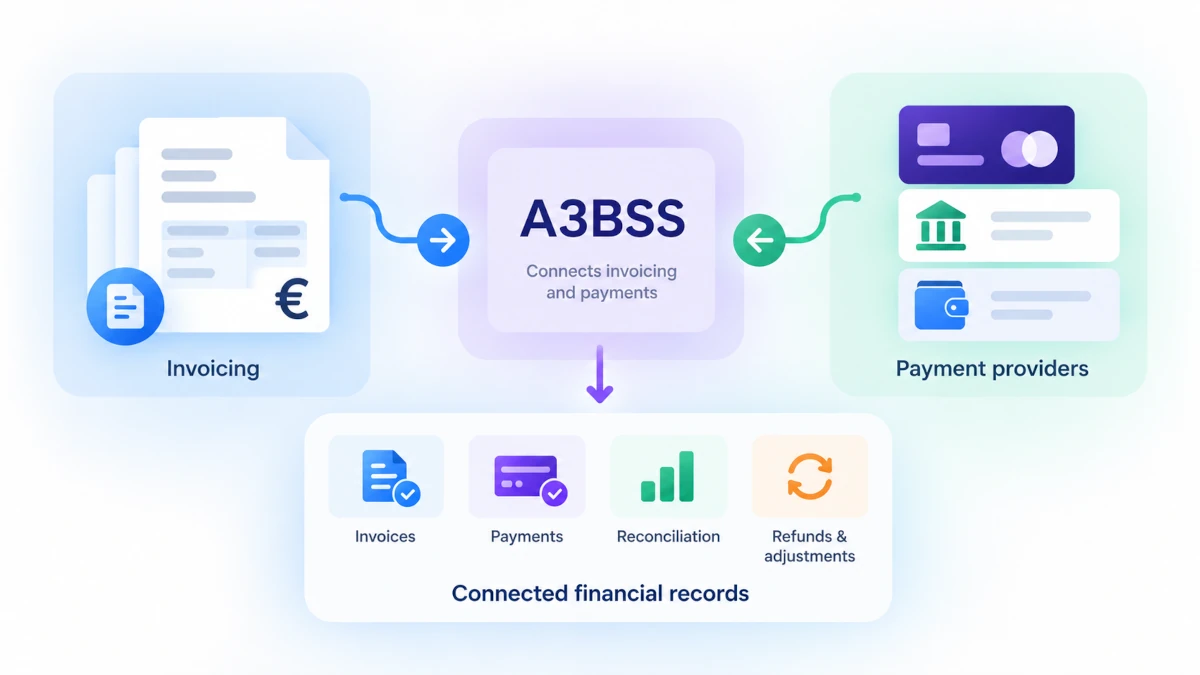
Summary
For many online businesses, invoicing and payment processing begin as separate activities.
An invoicing system generates documents for customers, while a payment provider processes transactions and reports their outcomes.
At a small scale, managing the relationship between these systems may be relatively straightforward.
As transaction volumes increase, however, the connections become more important.
Payments can fail, succeed after retries, cover multiple invoices, or result in refunds. Invoices can be corrected, partially paid, or issued before payment is collected.
Keeping these activities synchronized requires more than copying a payment status from one system to another.
Businesses need a reliable way to connect financial documents, payment transactions, and the events that occur throughout their lifecycles.
This article explores the architectural principles and practical considerations involved in building that connection.
1. Why invoicing and payments should remain separate but connected
Invoicing and payment processing are closely related, but they have different responsibilities.
An invoicing system manages financial documents and their associated records.
Depending on its scope, it may handle invoice generation, numbering, issuance, corrections, and links to customer or billing information.
A payment system manages the process of collecting money.
It may communicate with payment providers, create payment requests, process transaction notifications, and track payment attempts, refunds, or other financial events.
These responsibilities should not be confused.
For example, a payment can fail without making the original invoice invalid. Similarly, correcting an invoice does not automatically reverse a payment that has already been collected.
The systems need to exchange information while preserving the meaning and history of their respective records.
The problem with tightly coupled systems
Consider an application where every successful payment automatically creates an invoice, and every failed payment prevents invoice generation.
Such a workflow might work for certain business models, but it becomes restrictive when other scenarios arise.
What happens when a business needs to:
- Issue an invoice before requesting payment?
- Accept a bank transfer several days after issuing an invoice?
- Record a payment collected outside the application?
- Receive multiple partial payments against one invoice?
- Issue a correction document without changing the original payment?
- Use different payment providers for different customers?
A tightly coupled design may require exceptions and workarounds for each scenario.
A more flexible architecture allows invoicing and payment processing to operate independently while maintaining explicit relationships between their records.
This makes it easier to support different commercial workflows without treating every transaction identically.
2. Design around business records, not just status fields
One of the most common integration mistakes is reducing the relationship between invoicing and payments to a single field such as paid = true.
That field may be convenient for displaying information, but it cannot describe every financial situation.
Consider an invoice for €500.
A customer may make two payments of €200 and €300.
Alternatively, the customer might attempt to pay €500, encounter a failed transaction, and later complete a successful payment.
Both scenarios can eventually result in a fully paid invoice, but their transaction histories are different.
A reliable integration needs to retain those differences.
The essential records
A typical architecture may distinguish between the following entities:
| Record | Responsibility |
|---|---|
| Invoice | Documents the relevant charge or transaction |
| Payment attempt | Records an attempt to collect money |
| Payment transaction | Represents the resulting collection or other payment event |
| Payment allocation | Connects collected amounts to one or more invoices |
| Refund | Records money returned against an earlier payment |
| Settlement or payout | Describes the provider's subsequent financial processing |
These records do not necessarily have a one-to-one relationship.
An invoice may have several payment attempts.
A payment may be allocated to multiple invoices.
A refund may relate to only part of an earlier payment.
Maintaining these relationships makes the financial history more useful than a single summary status.
Example: Partial payments
Suppose a business issues an invoice for €600.
The customer pays €250 immediately and the remaining €350 one week later.
The invoicing system should be able to represent:
- Original invoice amount: €600.
- First payment allocation: €250.
- Outstanding amount after first payment: €350.
- Second payment allocation: €350.
- Final outstanding amount: €0.
The exact document and accounting treatment depends on applicable rules.
Nevertheless, the underlying payment records need to explain how the outstanding balance changed over time.
This becomes particularly important when a customer or finance team later investigates the transaction.
3. Use stable identifiers to connect systems
Reliable integrations depend on consistent references.
An invoicing application may identify a document using an internal database ID and a formal invoice number.
A payment provider may assign its own identifier to every transaction.
A billing platform may use another identifier for the subscription, order, or billing period.
These references serve different purposes, but they need to remain connected.
Internal and external references
A business might maintain information such as:
| Reference | Example |
|---|---|
| Internal invoice ID | inv_10425 |
| Invoice number | INV-2026-00425 |
| Internal payment ID | pay_10892 |
| Provider transaction ID | txn_example_7831 |
| Customer account ID | cus_215 |
These identifiers are illustrative.
The system should not assume that the external provider's transaction ID is also the invoice ID.
Instead, it should preserve the relationship explicitly.
This allows a transaction to be found from either side: starting with the invoice or starting with the provider's payment record.
Avoid matching by amount and date alone
Two customers may pay the same amount on the same day.
A customer may also make several identical payments for different services.
Matching records solely by amount and timestamp can therefore produce incorrect associations.
Stable identifiers and transaction references are more reliable.
Where providers support merchant-defined references or metadata, these can help preserve the relationship between an external payment and the corresponding business transaction.
However, external references should be validated rather than blindly trusted.
4. Handle payment events asynchronously
Many payment integrations rely on asynchronous notifications, commonly called webhooks.
A webhook allows a payment provider to notify a business application when a relevant event occurs.
For example, the provider may send a notification when a payment succeeds, fails, or is refunded.
This avoids requiring the business application to continuously request the latest status of every transaction.
However, asynchronous event processing introduces its own challenges.
Notifications can arrive more than once
A provider may retry a notification when it does not receive confirmation that the event was processed.
Consequently, the same event may be delivered multiple times.
If the application processes every notification as a new financial transaction, duplicate records can appear.
A robust integration should identify previously processed events and ensure that repeated delivery does not create duplicate financial effects.
Notifications may arrive out of order
A payment event generated earlier may arrive after a newer event.
For example, a delayed notification describing an earlier payment state could arrive after the application has already recorded a successful collection.
The system should not automatically replace the current state with an older one.
Instead, event handling should consider the provider's lifecycle rules, event identifiers, and authoritative transaction information.
Notifications can be delayed or missed
Network failures, temporary service outages, and configuration errors can interrupt event delivery.
A reliable integration should have a way to detect and recover from missing information.
This might include periodically checking unresolved transactions against the provider's API or retrieving events that were not processed successfully.
Verify notifications before processing them
Webhook endpoints are exposed to external requests.
Applications should authenticate notifications using the security mechanisms specified by the provider, such as signature verification.
Only validated events should be allowed to change financial records.
Together, these practices help prevent a temporary communication problem from becoming a permanent inconsistency between systems.
See Stripe's webhook documentation (opens in a new tab) for a provider-specific discussion of duplicate events, event ordering, retries, and signature verification.
5. Prevent duplicate financial operations
Duplicate processing is particularly dangerous in financial applications.
A repeated request might accidentally create two payment attempts, issue duplicate invoices, or apply the same refund twice.
One common technique for preventing duplicate operations is idempotency.
An idempotent operation produces the same intended result when the same logical request is processed repeatedly.
Example: A recurring billing event
Imagine a subscription renewal triggers an invoice-generation request.
The invoicing service creates the document successfully, but the response is lost because of a network timeout.
The billing application does not know whether the operation completed, so it retries.
Without appropriate safeguards, the second request could generate another invoice for the same billing event.
An idempotent design recognizes that both requests represent the same intended operation.
Instead of creating a second document, it returns or references the existing result.
Apply idempotency at the appropriate level
Idempotency should be considered separately for operations such as:
- Creating an invoice.
- Initiating a payment.
- Processing an incoming payment event.
- Recording a payment allocation.
- Initiating or recording a refund.
The safeguards used for one operation do not necessarily protect another.
For example, preventing duplicate webhook processing does not automatically prevent a business application from initiating two payment requests.
Idempotency keys, unique database constraints, and transactional processing can help, but the exact implementation depends on the system and provider.
An application also needs to understand the limits of external provider idempotency mechanisms, including any retention periods.
For an example of provider-specific behavior and limits, see Stripe's idempotent-request documentation (opens in a new tab).
6. Keep invoice, payment, and settlement states distinct
A common source of confusion is treating all financial statuses as interchangeable.
An invoice may be outstanding or paid.
A payment attempt may be pending, successful, failed, or canceled.
A provider settlement may be processing, completed, or included in a later payout.
These states describe different processes.
Example: A completed payment awaiting payout
Suppose a customer pays a €100 invoice by card.
The payment provider confirms that the customer's payment has been captured.
The associated invoice may now be eligible to be marked as paid, subject to the business's applicable rules.
However, the provider may not transfer the corresponding funds to the merchant's bank account until several days later.
The system therefore needs to distinguish:
- The customer's payment outcome.
- The invoice's outstanding balance.
- The provider's settlement or payout status.
Combining these into one state may create misleading information.
For example, an invoice should not necessarily remain marked as unpaid merely because the provider has not completed the merchant payout.
Similarly, a transaction should not be treated as collected merely because its authorization succeeded.
The goal is to preserve the meaning of each state while allowing the business to view them together.
Adyen's payment lifecycle documentation (opens in a new tab) illustrates why settlement and payout must remain distinct. For a broader explanation, see Understanding the Payment Lifecycle: From Authorization to Settlement.
7. Handle refunds and corrections as related but separate operations
Refunds and invoice corrections frequently occur together, but they are not identical.
A refund is a payment operation that returns money to the customer.
An invoice correction changes or supplements the financial documentation associated with the original transaction, according to applicable invoicing rules.
Consider a customer who purchases a service for €200 and subsequently receives a €50 refund.
The payment system needs to record the original payment and the refund.
The invoicing system may need to issue an appropriate correction document, depending on the transaction and applicable jurisdiction.
These activities should remain connected, but one should not be assumed to replace the other.
Preserve the relationship between records
A useful financial history might contain:
- Original invoice: €200.
- Original collected payment: €200.
- Refund event: €50.
- Related correction document, where required.
These records together explain what happened.
Deleting or silently rewriting the original transaction would make later investigations more difficult.
For businesses operating across jurisdictions, the invoicing treatment of refunds and corrections should be determined separately from the technical payment workflow.
8. Choose an integration architecture that fits the business
There is no single architecture suitable for every invoicing and payment integration.
The appropriate design depends on transaction volume, the number of providers, business processes, and operational requirements.
Three common approaches illustrate the trade-offs.
Direct integration
The business application integrates directly with an invoicing system and a payment provider.
The application is responsible for exchanging information and maintaining the relationships between records.
This approach may be sufficient when there are few integrations and relatively simple business requirements.
However, the application must handle provider-specific events, status mappings, and failure scenarios.
Central integration layer
A dedicated integration component sits between business applications and external services.
It receives payment events, translates provider-specific information into a consistent internal representation, and connects the resulting events with relevant business records.
This can be useful when a business operates multiple applications or payment providers.
It also creates an additional component that must be maintained, secured, and monitored.
Connected financial platform
A business may use a platform that provides invoicing and payment-related capabilities through a shared integration model.
Such a platform can reduce the amount of custom connection logic the business needs to maintain, depending on the supported features and integrations.
However, businesses should evaluate which responsibilities the platform actually handles.
Supporting payment integration, for example, does not automatically mean a platform processes or holds customer funds.
Similarly, connecting payment records does not necessarily imply that the platform provides accounting or full bank reconciliation.
The important consideration is whether the selected architecture establishes reliable connections without obscuring the responsibilities of the underlying systems.
9. Design for multiple payment providers
As businesses grow, they may add payment providers to support new markets, local payment methods, or different commercial arrangements.
Each provider may expose its own API, event types, transaction identifiers, and status terminology.
Without a consistent internal integration model, business applications can become dependent on provider-specific details.
For example, different providers might use different labels to indicate whether a transaction has been authorized, captured, settled, or refunded.
A central payment-tracking component can map relevant events into a consistent internal representation.
Standardize the meaning, not just the labels
Mapping every provider's "success" status to the same internal value may look convenient.
However, the underlying provider events may represent different financial milestones.
A good integration model preserves these distinctions.
The internal system should reflect what actually happened, even when the provider's terminology differs.
It should also retain the original provider reference and enough source information to investigate unusual cases.
Avoid unnecessary provider dependency
Where practical, business applications should use their own stable identifiers and internal financial relationships.
This makes it easier to introduce additional payment providers without redesigning invoice records or customer billing workflows.
It also allows historical transactions from previous providers to remain traceable.
10. Make financial integrations observable
Even well-designed integrations encounter failures.
A payment notification may be delayed, an API may become temporarily unavailable, or a record may contain inconsistent information.
A reliable system should make these situations visible.
Useful operational capabilities include:
Event processing history
A record of relevant incoming events and how they were handled.
Failed-operation tracking
Visibility into requests or notifications that could not be processed successfully.
Safe retries
Mechanisms to repeat failed operations without duplicating financial effects.
Unresolved payment references
A way to identify payments that cannot be associated with the expected invoice, order, or customer account.
Auditability
Enough information to understand when records were created or updated and which operation caused the change.
Sensitive payment or customer information should not be exposed unnecessarily in logs or diagnostic records.
The purpose of observability is not merely technical troubleshooting.
It also helps finance and support teams identify discrepancies and understand the financial history of customer transactions.
11. A practical integration checklist
Before putting an invoicing and payment integration into production, businesses should be able to answer several questions.
Data relationships
- Can every payment be associated with the relevant business transaction?
- Can an invoice have multiple related payments?
- Can a payment be allocated across multiple invoices when necessary?
- Are refunds and corrections traceable to the original records?
Event reliability
- Are incoming notifications authenticated?
- Can duplicate events be processed safely?
- Can the application handle delayed or out-of-order events?
- Is there a recovery process for missing updates?
Financial accuracy
- Are authorization, collection, settlement, and payout distinguished?
- Are invoice balances calculated using appropriate payment allocations?
- Are payment statuses interpreted according to the provider's actual semantics?
- Can finance teams investigate discrepancies without reconstructing records manually?
Operational resilience
- Are failures visible?
- Can operations be retried without creating duplicate records?
- Are external provider identifiers preserved?
- Is there an understandable history of important financial changes?
Not every business needs the same level of complexity.
Nevertheless, addressing these questions early can prevent operational problems as transaction volumes and integration requirements grow.
Final thoughts
Connecting invoicing and payments is not simply a matter of transferring a transaction status between two applications.
Reliable integration requires a clear understanding of the records each system manages and how those records relate to one another.
Invoices, payment attempts, collections, refunds, settlements, and corrections all represent different financial events.
Stable identifiers, asynchronous event handling, idempotent operations, and traceable financial histories make those connections more reliable.
For SaaS companies and online businesses, these foundations provide flexibility as transaction volumes increase, payment providers change, and financial workflows become more complex.
The objective is not necessarily to bring every operation into a single system.
It is to ensure that the systems involved can operate independently where appropriate while maintaining a consistent and understandable view of the business's financial activity.